

For a long time, my mornings felt rushed — no matter what I did. Even on days when I woke up early, I still felt like I was behind. I’d move quickly from one thing to the next, trying to keep up, but it never felt like enough. By the time I started work, I already felt mentally drained. At first, I thought the problem was time. But after paying closer attention, I realized something else was causing it. Once I fixed that, my mornings started to feel completely different.
What My Morning Looked Like Before
Before I changed anything, my mornings usually looked something like this:
I would wake up with enough time in theory, but I would immediately start reacting. I checked my phone, looked at messages, thought about everything I had to do, and then tried to move quickly through the rest of the morning. The problem was that I did not have a clear order. Some days I made coffee first. Some days I checked email first. Some days I tried to clean something up before starting work. Other days I lost time scrolling and then had to rush through everything else.By the time I actually started the day, I already felt behind. That was the pattern I wanted to fix.
What I Thought the Problem Was
At first, I thought I needed to wake up earlier. That seemed like the obvious solution. If I felt rushed, I probably needed more time. But after paying closer attention, I realized that waking up earlier did not always solve the problem. On some days, I still felt rushed even when I had enough time. That told me the issue was not only how much time I had. It was how I was using the first part of the morning. I was starting the day with too many decisions, too many distractions, and no clear first step.
I did not try to create a perfect morning routine. I only changed a few small things.
1. I stopped checking my phone first
This was the biggest change.
Checking my phone made the morning feel busy before it had even started. Even if I only looked for a minute, it usually pulled my attention into messages, notifications, news, or random things I did not need to deal with yet.
So I moved my phone away from the bed and waited until after the first part of my morning was done.
2. I picked the first three steps of the morning in advance
Instead of deciding what to do after waking up, I made the first few steps automatic:
- Get up
- Drink water
- Make coffee or breakfast
- Get ready for the day
- Start the first planned task
The exact steps are less important than having an order. Once I stopped deciding everything in the moment, the morning felt less chaotic.
3. I prepared one thing the night before
I did not prepare everything. That felt unrealistic.
Instead, I picked one small thing to make the next morning easier. Sometimes that meant choosing clothes. Sometimes it meant writing down the first work task. Sometimes it meant clearing my desk. Doing one small thing at night made the morning feel less cluttered.
4. I stopped trying to fit too much into the morning
Part of the problem was that I expected the morning to do too many jobs. I wanted to wake up, get ready, be productive, clean something, check messages, maybe exercise, maybe read, and still start work calmly.
That was too much. Once I made the routine smaller, it became easier to follow.
5. I gave myself a clear “start work” point
Before, my morning blurred into work. I would check one message, then one email, then think of something urgent, and suddenly the day had started without me choosing it. What helped was creating a clear starting point. Before that point, I focused on getting ready and setting up the day. After that point, I started work.
What Did Not Help
Waking up earlier did not help by itself. If I woke up earlier but still checked my phone, moved without a plan, and tried to do too many things, the morning still felt rushed. Adding more habits also did not help. A longer routine sounded good, but it made the morning feel more complicated. What helped most was making the morning simpler, not fuller.
The Real Reasons You Feel Rushed in the Morning
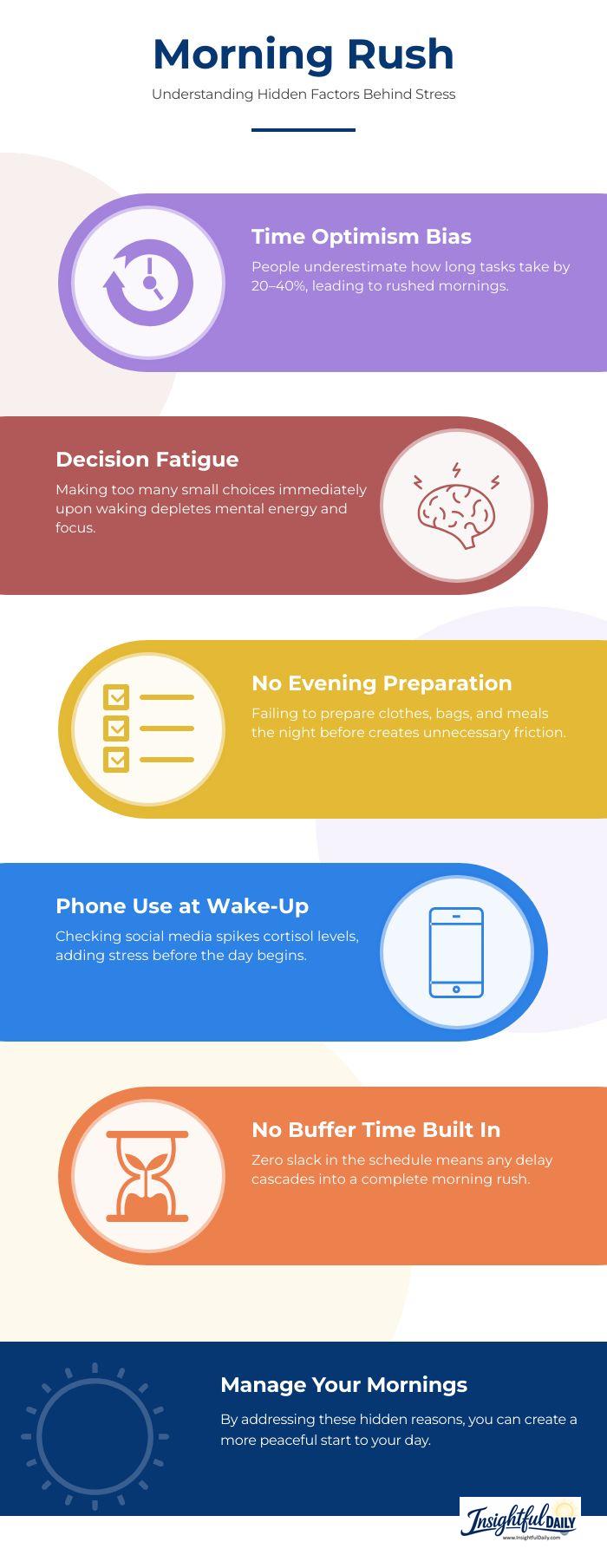
Understanding why you feel rushed in the morning requires looking beneath the surface. Most people assume they simply need to wake up earlier, but research and personal experience tell a more complicated story. The issue almost always comes down to a combination of poor time estimation, decision overload, and a lack of any structured preparation the evening before. If you’ve ever wondered why you still end up rushed in the morning even after setting an earlier alarm, these root causes are almost certainly the explanation.
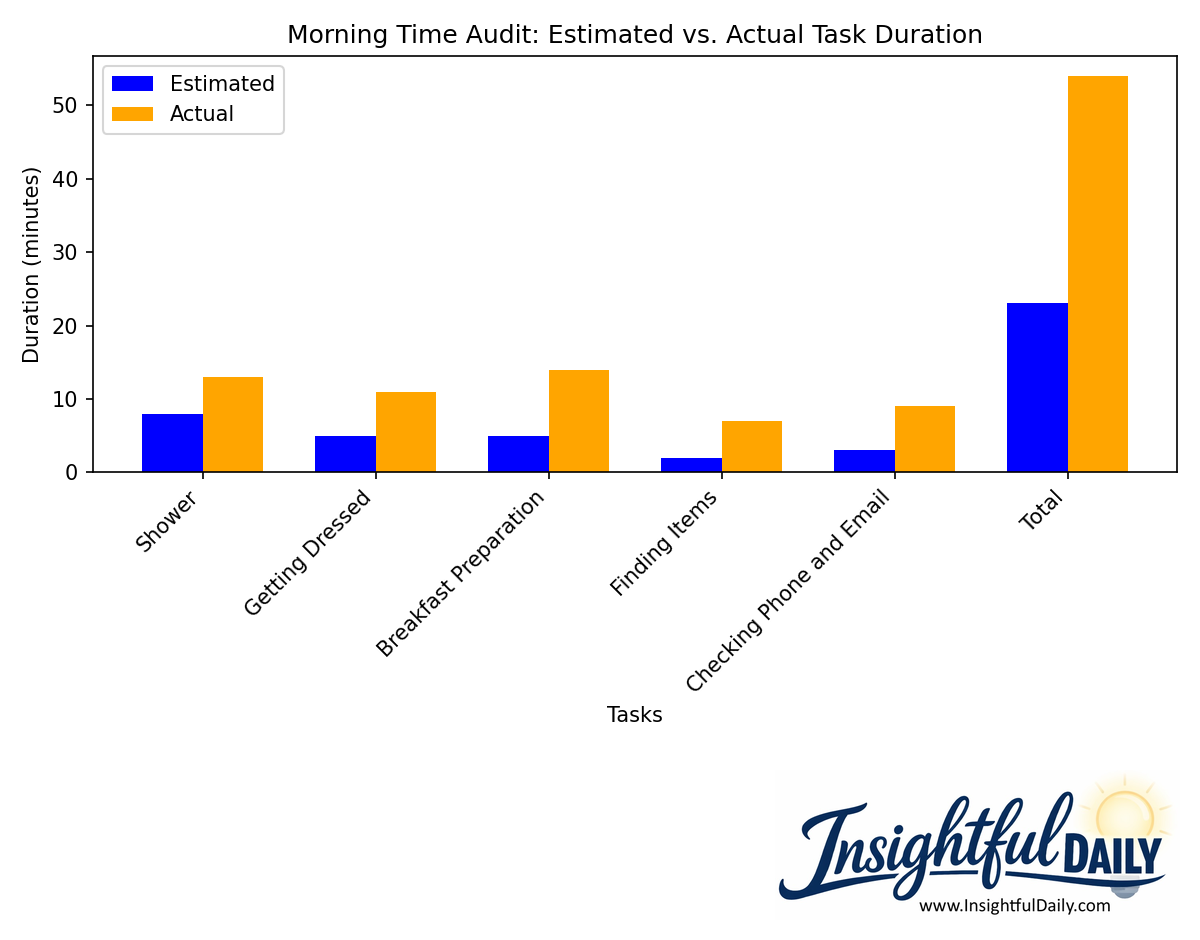
The phenomenon of time optimism bias is a massive contributor to morning stress. This is the deeply human tendency to underestimate how long tasks actually take. When you mentally budget 45 minutes for your morning routine, you’re probably imagining an idealized version of that routine — one where everything goes smoothly, you can find everything immediately, and you don’t get distracted. In reality, the average person’s actual morning routine takes significantly longer than their mental estimate. A quick shower becomes 12 minutes instead of 8. Finding matching socks takes 4 minutes instead of 30 seconds. Suddenly your 45-minute estimate has ballooned to over an hour, and you’re running late before you’ve even had breakfast. This gap between expectation and reality is one of the primary engines of the rushed in the morning experience that so many people share.
Decision fatigue is another major culprit behind feeling rushed in the morning. Every choice you make — what to wear, what to eat, whether to respond to that text — draws on a finite reservoir of mental energy. When you’re making dozens of small decisions the moment you wake up, your brain is working hard before the day has even begun. This creates a sense of cognitive overwhelm that you experience as rushing, even if you technically have enough time on the clock. The sensation of being behind is often a feeling of mental overload more than an actual time deficit. According to research published by the American Psychological Association, decision fatigue is a well-documented phenomenon that affects performance and emotional regulation throughout the day — and it starts the moment you begin making choices after waking.
Technology use in the morning is also worth examining honestly. The habit of reaching for your phone immediately upon waking — to check social media, news, or messages — activates stress pathways in the brain and spikes cortisol levels. You’ve gone from asleep to mentally processing a flood of external information in under two minutes. That reactive state is the opposite of the calm, intentional mindset that makes for a smooth morning, and it sets a tone of anxiety and reactivity that colors everything that follows — making you feel even more rushed in the morning than you otherwise would.
How Poor Evening Habits Create the Rushed in the Morning Feeling
One of the most powerful insights about time management morning routines is this: your morning doesn’t begin when you wake up. It begins the night before. The single biggest lever most people have available to them for reducing morning stress is building a consistent, intentional evening preparation ritual — and yet it’s the fix most people overlook because they’re focused entirely on morning behaviors. If you want to stop feeling rushed in the morning, the most effective place to start is actually the evening before.
Think about the things that create friction in your mornings. You can’t find your keys. You haven’t decided what to wear. There’s no food ready so you either skip breakfast or waste time throwing something together. Your bag isn’t packed. Your phone is dead because you forgot to charge it. Each of these friction points is entirely preventable with five to ten minutes of evening preparation, and yet collectively they can add 20 to 30 minutes of chaos to your morning — and, more importantly, they set a frantic emotional tone that makes you feel rushed in the morning before you’ve even left the house.
A practical evening routine doesn’t need to be elaborate. It simply needs to be consistent. Laying out tomorrow’s clothes takes about two minutes. Packing your bag or briefcase before bed takes three to five minutes. Preparing your coffee maker or setting out breakfast items takes another two minutes. Charging your devices overnight is a 10-second habit. When you add these small actions together into a nightly ritual, you essentially pre-solve all the problems that normally derail your morning before they have a chance to happen. Productivity researchers who study time management morning habits consistently find that people who invest 15–20 minutes in evening preparation report dramatically lower morning stress levels and leave the house meaningfully earlier on average. The Sleep Foundation also notes that going to bed with a sense of preparedness for the next day can improve sleep quality — meaning evening preparation pays dividends not just in your morning but in your rest as well.
The psychological benefit of evening preparation is also worth emphasizing. When you go to bed knowing that tomorrow is already organized, you sleep better. You wake up with a sense of control rather than a sense of impending chaos. That mental state — calm and prepared versus anxious and reactive — compounds throughout the day. Better mornings genuinely lead to better days, not just better commutes. If you struggle with morning stress and that perpetually rushed in the morning feeling, changing what you do the evening before is the highest-leverage intervention available to you.
Building a Better Morning Routine That Eliminates the Rush
Once you’ve addressed evening preparation, the next step is designing a better morning routine that fits your actual life rather than an aspirational lifestyle you saw on social media. The internet is full of elaborate morning routines involving 5 a.m. wake-ups, hour-long workouts, journaling, meditation, and cold plunges. While these things work wonderfully for some people, trying to force a complex, multi-hour morning ritual onto a life that doesn’t support it is a recipe for failure and more morning stress, not less. The goal of a better morning routine isn’t to be impressive — it’s to stop feeling rushed in the morning and start your day with a sense of calm control.
The most effective morning routines share a few characteristics regardless of their specific content. They are realistic about available time. They include buffer time — intentional slack built in to absorb unexpected delays. They front-load the non-negotiable tasks (hygiene, getting dressed, essential nutrition) and leave optional activities for after those are complete. And they are largely automatic, meaning they rely on habit and environmental design rather than willpower and decision-making each morning. When your routine runs on autopilot, you simply cannot feel as rushed in the morning because there’s no cognitive friction slowing you down.
The concept of habit stacking, developed by Stanford researcher BJ Fogg and popularized by James Clear in Atomic Habits, is enormously useful for morning routine design. The idea is to attach new behaviors to existing ones, creating a reliable chain of actions that flows without requiring conscious decision-making. For example: “After I turn off my alarm, I immediately put on my workout clothes (which I laid out the night before). After I put on my clothes, I go directly to the kitchen to start the coffee. After I start the coffee, I take three minutes to review my top priorities for the day.” Each action triggers the next, and the whole sequence becomes as automatic as brushing your teeth. People who use habit stacking in their morning routines report feeling significantly less rushed in the morning because the routine essentially runs itself.
Building buffer time into your morning is also non-negotiable if you want to stop feeling rushed. Most people schedule their mornings so tightly that any small disruption — a slow traffic light, a child’s last-minute request, an email that needs an urgent response — throws the entire timeline into chaos. Instead, aim to be fully ready to leave the house at least 10–15 minutes before you actually need to leave. Use that buffer to sit quietly, enjoy your coffee without rushing, or handle small unexpected tasks. On the days when nothing unexpected happens, you’ll simply leave a little early — which feels wonderful. On the days when something does go sideways, you’ll absorb it gracefully instead of starting your day in a panic, rushed in the morning and already behind before you’ve even arrived anywhere.
The Psychology of Feeling Rushed: It’s Not Always About Time
Here is something that took me a long time to fully appreciate: feeling rushed in the morning is not always — or even primarily — a time problem. It’s often an emotional and psychological problem that manifests as a time problem. This distinction matters enormously because if you only ever address the clock, you’ll never fully resolve the feeling of being rushed in the morning. You can have all the time in the world and still feel like you’re running behind if the underlying psychological drivers aren’t addressed.
Many people carry a background hum of anxiety into their mornings that has nothing to do with how many minutes they have available. Worry about the day ahead, unresolved stress from the previous day, general life anxiety — these emotional states create a physiological experience of urgency and rush even when there is technically plenty of time. If you find that you feel rushed in the morning even on days when you’re objectively ahead of schedule, this psychological dimension is worth exploring seriously. The feeling of being rushed in the morning can be a symptom of broader anxiety patterns that deserve attention beyond just morning routine optimization.
Mindfulness practices, even very brief ones, can be transformative for morning stress. Taking three to five minutes immediately after waking to simply sit quietly — without your phone, without the news, without any external input — allows your nervous system to transition gently from sleep to wakefulness rather than being jolted into reactivity. Some people find that a brief meditation helps. Others prefer to sit with their coffee and look out a window. The specific activity matters less than the principle: give your mind and body a few minutes to arrive at the day before you start asking them to perform in it. This simple practice alone can dramatically reduce how rushed in the morning you feel, even before you’ve changed a single logistical element of your routine. Resources like Headspace offer guided morning meditations specifically designed to ease the transition from sleep to an alert, calm waking state.
Reframing your relationship with your morning is also genuinely useful. Rather than treating the morning as an obstacle course to survive before getting to the “real” part of your day, consider cultivating a small sense of appreciation for it. The morning is the one part of the day that is most fully yours — before the demands of work, family, and the outside world have fully claimed your attention. Protecting even a few minutes of that space for something you genuinely enjoy — a good cup of coffee, a few pages of a book, a brief walk outside — can transform your psychological relationship with morning entirely. You can also explore strategies for a digital detox to reduce the technology-driven anxiety that fuels the rushed in the morning feeling so many people experience.
Practical Time Management Morning Strategies That Made a Real Difference
Beyond the broad principles, there are specific time management morning tactics that have measurably improved mornings for people who’ve committed to them. These aren’t hacks or tricks — they’re structural changes that address the root causes of feeling rushed in the morning rather than just treating the symptoms. If you implement even two or three of these strategies consistently, you will notice a meaningful reduction in how rushed in the morning you feel within just a few weeks.
The first strategy is doing a time audit of your actual morning. For one week, time every single task in your morning routine with a stopwatch and record the results honestly. Most people are genuinely shocked by what they find. The data almost always reveals that the morning routine takes significantly longer than expected, and it typically reveals one or two major time sinks that aren’t obviously visible until they’re measured. This empirical information allows you to redesign your routine based on reality rather than optimism — which is the only way to truly stop being rushed in the morning on a consistent basis.
The second strategy is the “ready time” technique. Instead of calculating forward from when you wake up (“I’ll wake up at 7 and leave by 8”), calculate backward from when you need to leave. If you need to leave at 8 a.m. and your actual measured routine takes 65 minutes, you need to be awake by 6:55 at the latest — with some buffer, call it 6:45. Most people are calculating forward with optimistic estimates and ending up perpetually rushed in the morning and late. Calculate backward with realistic measurements and you’ll hit your departure time consistently, transforming your experience from rushed in the morning to calm and on time.
The third strategy involves reducing the number of morning decisions through systematic preparation. This means not just laying out clothes the night before, but going further: meal prepping breakfasts for the week on Sunday evening, creating a permanent designated spot for keys and bag so you never spend a moment searching, and establishing a fixed morning sequence that you don’t deviate from. Every decision you can eliminate or relocate to a different time of day is mental bandwidth freed up for a calmer, more focused morning experience. This is especially valuable if you’re also managing a household with children, where the decision and coordination load in the morning can be genuinely overwhelming and where feeling rushed in the morning can affect the entire family’s emotional state for the day.

Who This May Help
This may help if you often feel rushed even when you technically have enough time. It may also help if your mornings feel scattered, if you check your phone first thing, or if you start the day without a clear order. It may not solve everything if your schedule is unpredictable, your mornings depend on children or caregiving, or you are simply not getting enough rest. But if the problem is morning chaos, a smaller and clearer routine can make a noticeable difference.
The problem was not that I needed a perfect morning routine. The problem was that I was starting the day by reacting to everything. Once I made the first part of the morning simpler and more predictable, I felt less rushed.