

I didn’t expect much from a simple morning walk. It felt almost too basic to make a real difference. But after a few weeks of feeling low energy and mentally scattered in the mornings, I decided to try something small: For 7 days, I went for a walk every morning. No intense workouts. No complicated routine. Just a simple walk to see if it would change anything. Here’s what actually happened.
The 7-Day Morning Walk Experiment
What I tested: Taking a simple walk every morning for 7 days.
Why I tried it: My mornings had started to feel low-energy and mentally scattered. I wanted to see whether getting outside before the day became busy would make the morning feel more grounded.
What counted as a walk: This was not an intense workout. I kept it simple — a short walk at an easy pace.
What I paid attention to: How I felt before starting the walk, how the morning felt afterward, whether I felt less rushed, and whether the habit was easy enough to repeat.
What I did not track: I did not measure fitness, weight loss, medical outcomes, or anything clinical. This was a personal routine experiment, not health advice.
Important note: This article is based on one short personal experiment. A morning walk may feel helpful for some people, but everyone’s schedule, energy level, health, and responsibilities are different.
What My Mornings Felt Like Before
Before trying this, my mornings often felt scattered. I would wake up, think about everything I needed to do, check my phone, move through the first part of the day quickly, and still feel like I had not really started with any direction. The issue was not that my mornings were terrible. They just felt unfocused. I wanted something simple that could create a clearer transition between waking up and starting the rest of the day. A short walk seemed easy enough to test because it did not require equipment, planning, or a complicated routine.
Why Morning Walk Benefits Go Beyond Basic Exercise
There’s something uniquely powerful about walking in the morning specifically, and it has to do with more than just burning calories. When you step outside in the early hours of the day, your body receives a cascade of biological signals that set the tone for everything that follows. The natural morning light — even on a cloudy day — is dramatically brighter than indoor lighting and plays a critical role in regulating your circadian rhythm, the internal 24-hour clock that governs when you feel awake, hungry, focused, and sleepy. By exposing your eyes to natural light within the first hour of waking, you’re reinforcing your sleep-wake cycle in a way that no supplement or sleep tracker can replicate. This is one of the most underappreciated morning walk benefits — the effect isn’t just physical, it’s deeply neurological.
Beyond the light exposure, walking in the morning also means your cardiovascular system gets a gentle but meaningful workout before the stress and sedentary time of a typical workday can accumulate. Research published in the European Journal of Preventive Cardiology found that even modest daily step counts — achievable with a single morning walk — meaningfully reduce the risk of cardiovascular mortality. Your heart rate elevates, blood flow improves, and oxygen delivery to your muscles and brain increases. Cortisol, which naturally peaks in the morning as part of a healthy circadian rhythm, gets channeled productively rather than building as background stress. The result is that by the time you’re sitting at your desk or going about your day, your body has already processed its morning stress hormones constructively rather than letting them linger.
This combination of light, movement, fresh air, and the psychological sense of accomplishment that comes from doing something positive before the day has even started makes morning walking uniquely effective among simple routines — it stacks multiple morning walk benefits at once rather than targeting just one area of wellness. That stacking effect is precisely why so many health professionals recommend it as a foundational habit before adding anything more complex to a wellness routine.
What Happens to Your Body Day by Day: The 7-Day Morning Walk Timeline
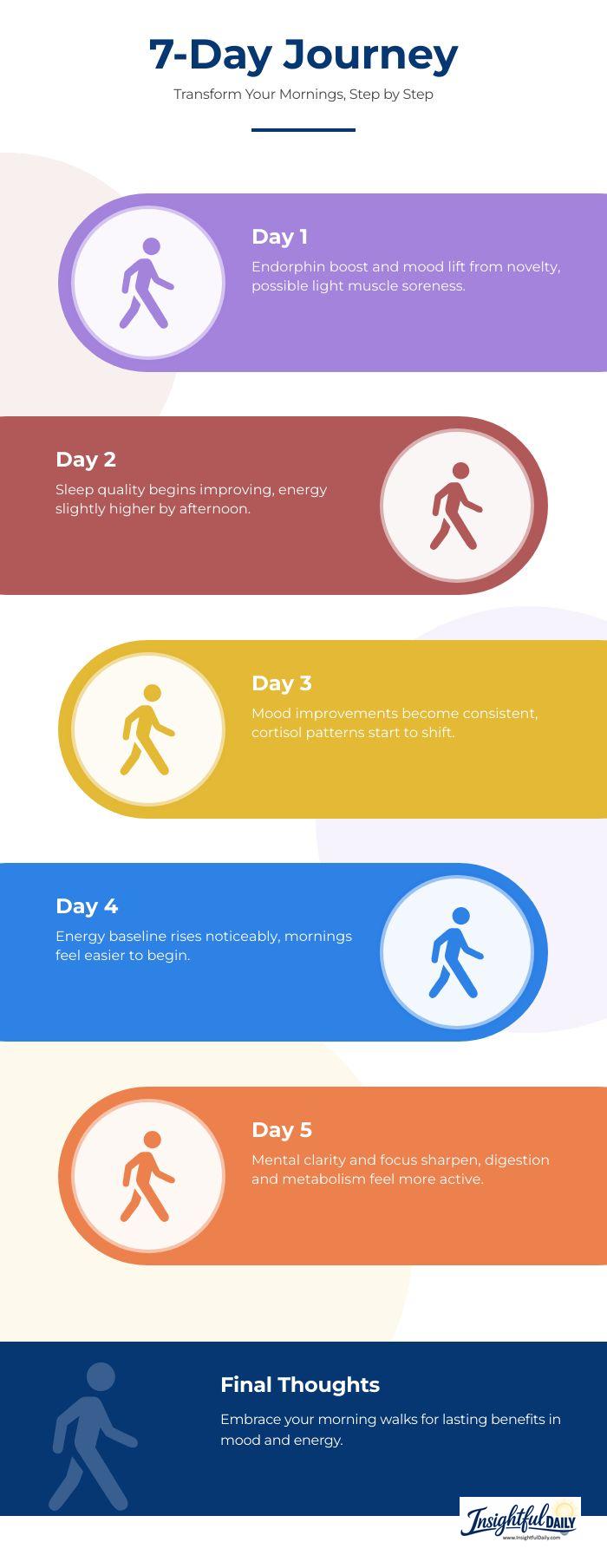
What Happened During the 7 Days
Day 1: It felt almost too simple
The first morning did not feel dramatic. I went for a short walk, came back, and started the day. The main thing I noticed was that the walk gave me a clean break between waking up and jumping into tasks. Instead of going straight from bed to phone or work, there was a small pause in between.
Day 2: Getting started was the hard.
The hardest part was not the walk itself. It was getting out the door before the day started pulling my attention elsewhere.
Once I was outside, the habit felt easy. But if I waited too long, I could tell it would be much harder to actually do.
Day 3: My morning felt less scattered
By the third day, I started to notice that the walk gave the morning a clearer shape.
I was not suddenly full of energy. But I did feel less mentally scattered when I came back. It was easier to start the day because I had already done one simple thing on purpose.
Day 4: I stopped treating it like exercise
This was an important shift. When I thought of it as exercise, I felt like it needed to be longer, faster, or more impressive. When I treated it as a morning reset, it felt much easier to maintain. That made the habit feel less intimidating.
Day 5: The timing mattered
The walk helped most when I did it early, before checking messages or getting pulled into the day. If I waited until later, it became just another task to fit in. When I did it first, it felt more like a transition into the day.
Day 6: I did not always feel like doing it
There were still mornings when I did not feel motivated. That was useful to notice. The habit only worked because I kept it small. If I had tried to turn it into a long workout, I probably would have skipped it.
Day 7: The biggest change was the start of the day
By the end of the week, the biggest change was not physical. It was how the morning started. The walk created a calmer beginning. It gave me a few minutes before screens, messages, and decisions took over.
The Mental Health and Mood Benefits of a Daily Walking Habit
The mental health dimension of the morning walk benefits picture is arguably where the most dramatic short-term changes are felt. Walking — particularly in natural environments — has a well-documented effect on the brain’s stress circuitry. Researchers at Stanford University have found that walking in natural settings reduces activity in the subgenual prefrontal cortex, a region of the brain associated with repetitive negative thinking and rumination. This is a genuinely measurable neurological change, not just a feeling of relaxation, and it can occur after even a single walk. Over seven days, this effect compounds, and many people find that their general anxiety level decreases noticeably. For anyone who has struggled with persistent low-level worry or mental chatter, this particular aspect of morning walk benefits can feel almost transformative.
There’s also the effect of what researchers call “optic flow” — the visual experience of the world moving past you as you walk. This rhythmic visual stimulation has been shown to reduce amygdala activation, essentially turning down the volume on your brain’s threat-detection center. In practical terms, this means that things that might normally feel overwhelming or anxiety-provoking feel slightly more manageable after a morning walk. People dealing with work stress, relationship pressures, or general life anxiety frequently report that their morning walk is the single most effective tool in their mental wellness toolkit — more effective, in their experience, than many other interventions they’ve tried. This is one of the morning walk benefits that tends to convert skeptics into lifelong advocates.
Serotonin and dopamine production also increase with regular aerobic activity. These neurotransmitters are directly linked to motivation, mood stability, and feelings of well-being. Within the first week of establishing a daily walking habit, most people notice not just that they feel better during and after the walk, but that their baseline mood throughout the entire day improves. This is a cumulative effect that builds with each consecutive morning. If you’re also dealing with symptoms of mild depression or low motivation, research consistently shows that regular aerobic exercise — including walking — produces effects comparable to antidepressant medication for mild-to-moderate cases, though this should always be discussed with a healthcare provider rather than used as a standalone treatment. The mental health dimension of morning walk benefits is one of the most evidence-rich areas in exercise science.
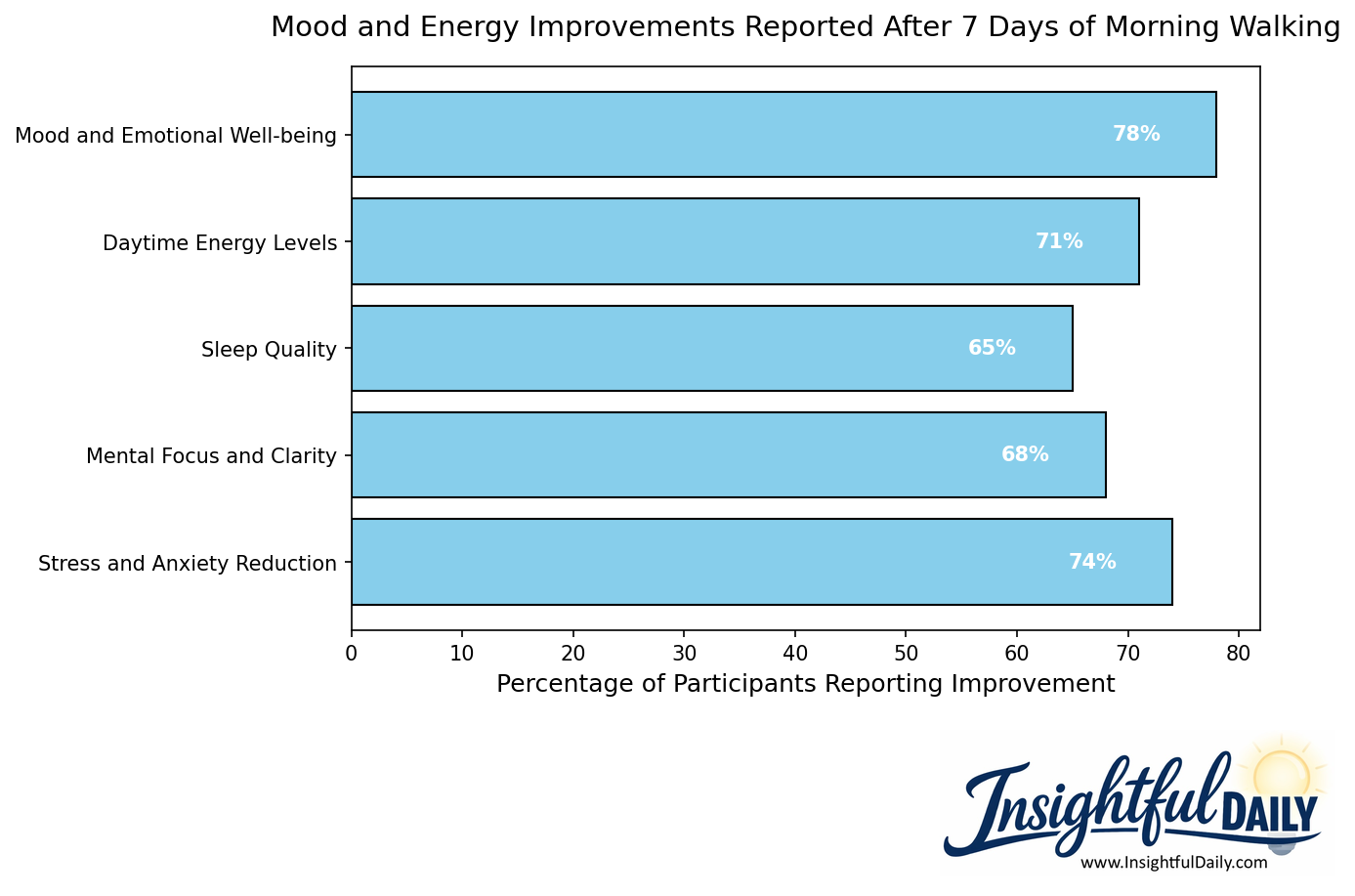
Morning Walk Benefits for Physical Health: Heart, Metabolism, and More
On the physical side, a week of morning walks sets off a chain reaction of positive changes in your body that go well beyond simple calorie burning. Your cardiovascular system benefits almost immediately — even a single walk lowers blood pressure for several hours afterward, a phenomenon known as “post-exercise hypotension.” Over seven days of consistent walking, your resting heart rate may begin to decrease slightly as your heart becomes more efficient at pumping blood. For people who are sedentary or only lightly active, these cardiovascular morning walk benefits can be surprisingly pronounced even within a single week. The American Heart Association recognizes brisk walking as one of the most accessible and effective forms of cardiovascular exercise available to adults of all fitness levels.
Metabolic health also improves meaningfully with consistent morning walking, particularly for blood sugar regulation. A single 15-to-20-minute walk after breakfast has been shown in clinical studies to blunt post-meal blood glucose spikes by up to 30% compared to remaining sedentary. Over the course of a week, this adds up to significantly lower average blood glucose levels and improved insulin sensitivity — factors that are critically important for long-term metabolic health, weight management, and reducing the risk of type 2 diabetes. If you’ve been curious about intermittent fasting and its metabolic effects, pairing it with a fasted morning walk amplifies the fat-oxidation benefits of both approaches, making the combination particularly powerful for metabolic health.
For those concerned about vitamin D levels — a surprisingly widespread deficiency — morning walking outdoors provides a natural opportunity for sun exposure. Spending even 15-20 minutes outside in morning sunlight (with arms and legs partially exposed on warmer days) supports vitamin D synthesis, which plays a critical role in immune function, bone health, and mood regulation. If you’ve been experiencing fatigue, low mood, or muscle weakness, it’s worth checking our article on vitamin D deficiency symptoms to understand whether your morning walks might be addressing an underlying deficit. This sun-exposure dimension of morning walk benefits is particularly relevant for people who work indoors and rarely get natural light during the day.
Weight management, while not a dramatic outcome within a single week, does begin with consistent walking. A 30-minute moderate-pace walk burns approximately 150-200 calories depending on body weight and pace. More importantly, regular morning exercise tends to reduce cravings for high-sugar, high-fat foods throughout the day — a behavioral effect mediated by improved leptin sensitivity and better regulation of hunger hormones. Many people find they naturally make better food choices on days when they’ve walked, creating a positive feedback loop between their exercise habit and their overall diet quality. These compounding physical morning walk benefits are what make the habit so valuable as a long-term health investment.
What Helped Most
The most helpful part was keeping the walk simple. I did not set a step goal. I did not turn it into a workout plan. I did not try to optimize anything. I just used the walk as a short reset before the day became busy. That made it easier to repeat.
What Did Not Help
Trying to make the walk too ambitious did not help. The more I thought about making it longer, faster, or more productive, the less appealing it became. The habit worked best when it stayed easy. Waiting too long also did not help. If I checked my phone, opened messages, or started work first, the walk became much easier to skip.
What I Would Do Differently
If I tried this again, I would make the walk even easier to start. I would set out shoes the night before, avoid checking my phone first, and decide on a simple route ahead of time. The less I had to decide in the morning, the more likely I was to actually do it.
Who This May Help
This may be useful if your mornings feel rushed, scattered, or too screen-heavy. It may also help if you want a simple transition between waking up and starting work or daily responsibilities. It may not be realistic for everyone. Weather, safety, schedule, caregiving responsibilities, health, or mobility needs can all affect whether a morning walk makes sense. The point is not that everyone needs to walk every morning. The point is to test whether a small, repeatable morning reset helps your day feel easier to start.

Final Takeaway
Taking a walk every morning for 7 days did not completely transform my life. But it did make my mornings feel less scattered. The biggest benefit was not that the walk was impressive. It was that it gave the day a calmer starting point. For me, the habit worked because it was simple, repeatable, and easy to understand: get outside for a few minutes before the day starts moving too fast. That was enough to make the morning feel a little easier to manage.
Note: This is a personal experience, not health advice.