
A few weeks ago, I had one of those days where I was constantly busy — but somehow got nothing meaningful done. I answered messages, checked emails, switched between tasks, and stayed “active” all day. But by the evening, I couldn’t point to a single thing that actually moved forward. That’s when it hit me. I wasn’t unproductive because I was lazy. I was unproductive because I was busy in the wrong way. So I started paying attention to what was actually happening during my day. Here’s what I noticed.

Why I Felt Busy All Day — But Got Nothing Done
For a while, I ended every day feeling exhausted — but when I looked back, I couldn’t clearly point to what I had actually finished. I was constantly doing something: replying, checking, organizing, switching tasks. But very little of it felt meaningful by the end of the day. That’s when I realized the problem wasn’t effort. It was that I wasn’t tracking real progress at all.
The exhaustion is real, but it comes from the wrong kind of work. Your nervous system does not care whether the last eight hours were spent solving a complex problem that moves your career forward or cycling through your inbox — it registers effort either way, and it demands rest either way. This is why so many people describe their days as both exhausting and pointless simultaneously. According to research published in the Harvard Business Review by Teresa Amabile, the single biggest driver of positive inner work life is making progress on meaningful work — not simply staying active.
Cal Newport’s foundational concept of deep work versus shallow work is essential here. Deep work refers to cognitively demanding, high-value tasks performed in a state of focused concentration — writing, coding, designing, strategic analysis. Shallow work refers to the logistical, low-cognitive tasks that fill most people’s days — emails, routine meetings, administrative tasks. Studies referenced in Newport’s research suggest that the average knowledge worker spends only 10 to 20 percent of their working hours in genuine deep work. The remaining 80 percent is shallow work that creates the sensation of busyness without producing proportional results. When you are always busy but rarely entering states of deep, focused work, the outcome at the end of the day will always feel thin — and the cycle of feeling unproductive busy will continue unchecked.
Common Productivity Mistakes That Keep You Feeling Unproductive Busy
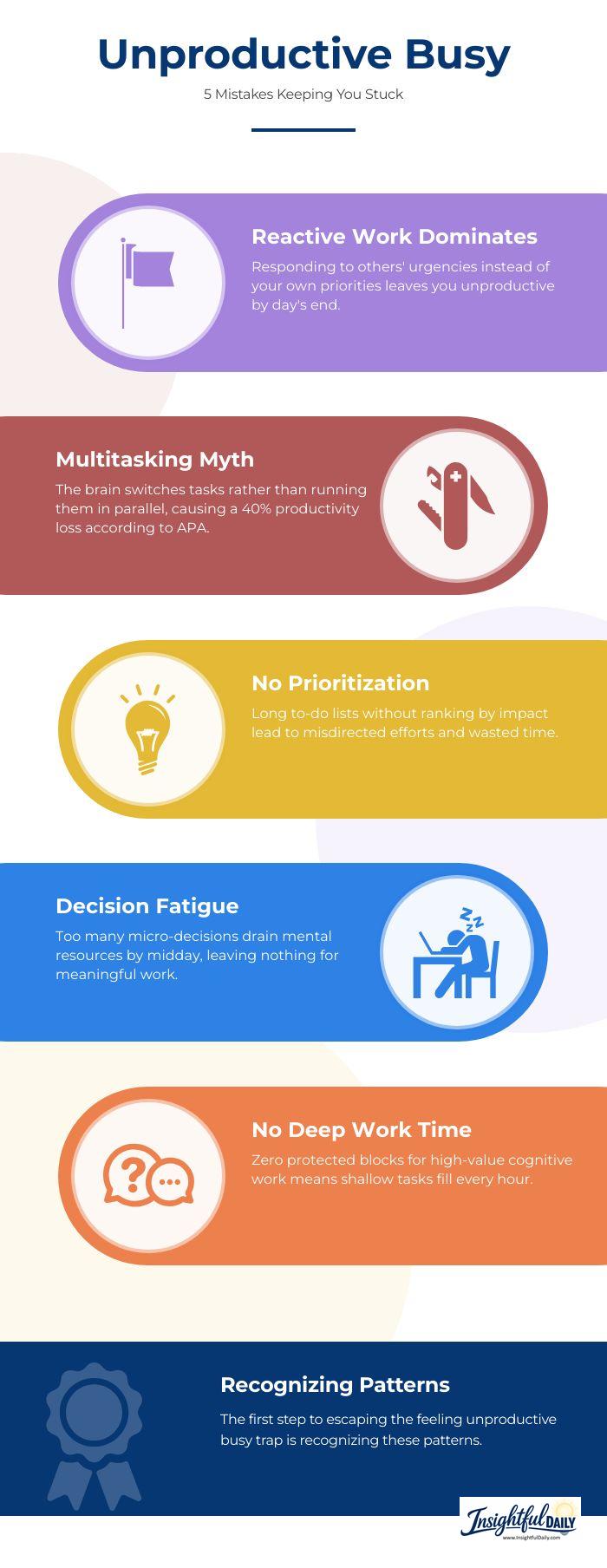
One of the most widespread productivity mistakes people make is allowing reactive work to dominate their schedule. Reactive work means responding to whatever comes to you — the email that just arrived, the message that just pinged, the colleague who just dropped by — rather than proactively working on what actually matters most. This reactive habit feels productive because there is always something to respond to, always a small fire to put out. But it means your priorities are being set by other people’s urgencies rather than your own goals. By the end of the day, you have served everyone else’s agenda and none of your own, leaving you feeling unproductive busy despite having been in constant motion.
Another devastating productivity mistake is multitasking. Despite the cultural glorification of the ability to juggle multiple things simultaneously, research from the American Psychological Association has definitively shown that multitasking reduces productivity by up to 40 percent. People who consistently multitask are less capable of filtering irrelevant information, experience degraded working memory, and take longer to complete individual tasks. The cost is not just efficiency — it is the quality of thinking you bring to your most important work. If you are writing a report while monitoring your email while half-listening to a podcast, none of those three things are getting the cognitive resources they deserve, and all three outputs suffer. This fragmented approach to work is one of the primary drivers of the feeling unproductive busy cycle that so many professionals cannot seem to escape.
Lack of prioritization is the third major trap. Most people confuse having a long to-do list with having a productive plan. A to-do list with twenty items on it is not a productivity system — it is an anxiety catalog. Without clear prioritization, people naturally gravitate toward the easiest, most satisfying tasks first (known as “task completion bias”), leaving the most important, most impactful work for later, when mental energy has already been depleted. By the time you get to the tasks that actually matter, you are running on fumes. This pattern is one of the most common reasons people report feeling unproductive busy — they were active all day, but the activity was misdirected from the start.
The biggest thing I noticed was that I rarely defined what “done” actually meant before starting my day. So even when I stayed active for hours, it was hard to feel progress. Everything blended together into one long stream of small tasks and interruptions. One thing I realized quickly was that my schedule looked full — but it wasn’t intentional. I was filling my time as things came up, instead of deciding in advance what actually mattered. That made every day feel busy, but not productive.
Focus Problems: Digital Distraction and the Hidden Cost of Constant Interruption
In 2026, focus problems have reached crisis levels for the modern knowledge worker. The average professional is now juggling notifications from email, Slack, Microsoft Teams, AI assistants, social media, news apps, and calendar reminders — all simultaneously competing for attentional bandwidth. A landmark study from the University of California, Irvine found that it takes an average of 23 minutes and 15 seconds to fully regain deep focus after a single digital interruption. If you are being interrupted even five to ten times per day (a conservative estimate for most remote workers), you are losing hours of productive focus time to recovery — time that does not show up on any calendar but is absolutely felt by the end of the day. This invisible focus debt is one of the most underappreciated reasons people find themselves feeling unproductive busy despite working long hours.
Mental fatigue compounds focus problems significantly. Decision fatigue — the cognitive exhaustion that results from making too many decisions over the course of a day — is one of the least-discussed but most powerful drivers of unproductive busyness. Research by Roy Baumeister on ego depletion demonstrates that the quality and willpower behind our decisions deteriorates progressively throughout the day. When you spend your morning triaging emails, deciding which meeting to accept, choosing which task to tackle first, and navigating interpersonal office dynamics, the mental fuel needed for creative, strategic, high-value work has already been burned through by lunch. What remains is the ability to stay busy — answering things, attending things, reacting to things — without the cognitive resources to do anything genuinely meaningful. This is the neurological engine behind the feeling unproductive busy experience: you are genuinely exhausted, but from the wrong kind of work.
Unclear goals are also a major focus problem that rarely gets addressed honestly. If you do not know with sharp clarity what your top one to three priorities are for the day — not the twenty things on your list, but the three that would actually move the needle — your brain defaults to busyness as a substitute for direction. Teresa Amabile’s research at Harvard Business School found that the single biggest contributor to a positive sense of daily accomplishment is making clear progress on work that matters. Without clarity on what “work that matters” looks like for you, every task looks equally valid, and the loudest, most urgent tasks will always crowd out the most important ones. If you want to learn more about how mental clarity affects other areas of your life, our article on digital detox benefits and disconnecting from technology explores how reducing digital noise can restore mental bandwidth and help break the feeling unproductive busy cycle.
What I Actually Changed: Practical Shifts That Broke the Feeling Unproductive Busy Cycle
After years of experiencing the exhausting cycle of feeling unproductive busy despite working long hours, the changes that actually made a difference were structural, not motivational. The first shift was adopting the MIT (Most Important Task) method every morning. Before opening email, before checking Slack, before doing anything reactive, I identify one to three tasks that — if completed — would make the day genuinely successful. These are not necessarily the most urgent tasks. They are the most impactful ones. By anchoring the morning to these priorities before the noise of the day begins, there is a dramatically higher chance that the most meaningful work gets done before the inevitable reactive tide rolls in. This single habit did more to address my feeling unproductive busy problem than any app, system, or productivity book I had ever tried.
The second change was time-blocking with hard boundaries. Rather than maintaining a vague list of things to do, I began scheduling specific two-hour blocks on my calendar for deep work — no notifications, no email, no social media. These blocks are treated like external meetings that cannot be cancelled. This practice, drawn from Cal Newport’s deep work methodology, was uncomfortable at first because it required saying no to small interruptions that felt important in the moment. But the results were undeniable: tasks that used to take a fractured, anxious full day began finishing in focused two-hour sessions, leaving the rest of the day for communication and planning without guilt. The feeling unproductive busy sensation that had plagued my evenings began to lift almost immediately.
The third change was reducing my daily decision load by creating routines and defaults. Rather than deciding each morning when to exercise, what to eat, when to check email, and what to work on first, I turned these decisions into automatic behaviors governed by a fixed morning routine. Research on habit formation and decision fatigue is clear on this: the fewer decisions you make before your first deep work session, the more cognitive energy you have for work that actually matters. Even small things — having a default lunch, a set email-checking schedule (twice a day rather than continuously) — compound into meaningful protection of mental resources. For anyone who has been feeling unproductive busy for an extended period, reducing decision fatigue is often the missing piece that makes all other productivity strategies finally click into place.
Finally, I began ending each day with a brief five-minute review — not a lengthy journaling session, but a quick honest accounting of whether the day’s most important tasks were completed, and why or why not. This habit creates accountability to yourself, helps you spot patterns in what consistently derails your priorities, and provides a daily evidence-base that the feeling of unproductivity does not always reflect reality. Some days, you will realize you accomplished more than you felt you did. Other days, the review will reveal the exact distraction or time management issue that ate your most valuable hours. Both outcomes are productive information that helps you break the feeling unproductive busy cycle over time.

After paying attention for a few days, I started to notice a pattern. Most of my time wasn’t going toward important work. It was going toward reacting — replying, checking, switching, adjusting. Individually, each task felt small. But together, they filled the entire day without producing anything meaningful. Looking back, the problem wasn’t motivation. It was how I was using my time. Once I stopped measuring my day by how busy it felt — and started measuring it by what actually progressed — work became much less mentally draining. Even small amounts of meaningful progress felt better than an entire day of reacting to things.
Note: This is a personal experience, not psychological advice.