

After work, I often told myself I was relaxing — but most evenings still ended with more scrolling, more videos, and more screen time. So I tried reducing screen time after work for one week. I didn’t remove technology completely. I just created a clearer cutoff and replaced some screen time with quieter evening routines. The biggest change was that my evenings started to feel less scattered.
Why After-Work Screen Time Is the Most Damaging Part of Your Day
There’s a particular cruelty to the after-work hours. You’re mentally depleted from a full day of meetings, decisions, and digital communication, yet the most common response to that exhaustion is to collapse onto the couch and immediately fill your brain with more digital content — Instagram feeds, Netflix autoplay, YouTube rabbit holes, or mindless news scrolling. From a neuroscience standpoint, this is one of the worst things you can do for your cognitive recovery. The prefrontal cortex, which governs focus, decision-making, and emotional regulation, has been working hard all day. It needs genuine downtime, not a different flavor of stimulation. This is precisely why so many health researchers and sleep scientists now argue that the choice to reduce screen time after work is one of the most impactful behavioral changes a working adult can make.
The problem is compounded by what researchers call screen addiction habits — the deeply grooved behavioral patterns that make reaching for your phone feel as automatic as breathing. In 2026, the average adult checks their smartphone approximately 96 times per day, with the peak usage window falling squarely between 7 PM and 10 PM, according to DataReportal’s Digital 2026 Global Overview Report. This is precisely the window when your brain should be transitioning toward rest, winding down cortisol production, and beginning melatonin release in preparation for sleep. Instead, the combination of blue light exposure and emotionally activating content — from social media arguments to stressful news cycles — keeps your nervous system in a state of low-grade alert that prevents genuine relaxation.
Blue light specifically is problematic because it suppresses melatonin production by up to 50% when screens are used within two hours of bedtime, according to research published in the Journal of Clinical Sleep Medicine. This doesn’t just mean you fall asleep later — it means the quality of sleep you do get is measurably lighter, more fragmented, and less restorative. The downstream effects show up the next morning as grogginess, reduced focus, and a reliance on caffeine to get back to baseline. Understanding this cycle is what motivated the seven-day experiment to reduce screen time after work, and the results were more dramatic than expected.
The 7-Day Reduce Screen Time After Work Protocol
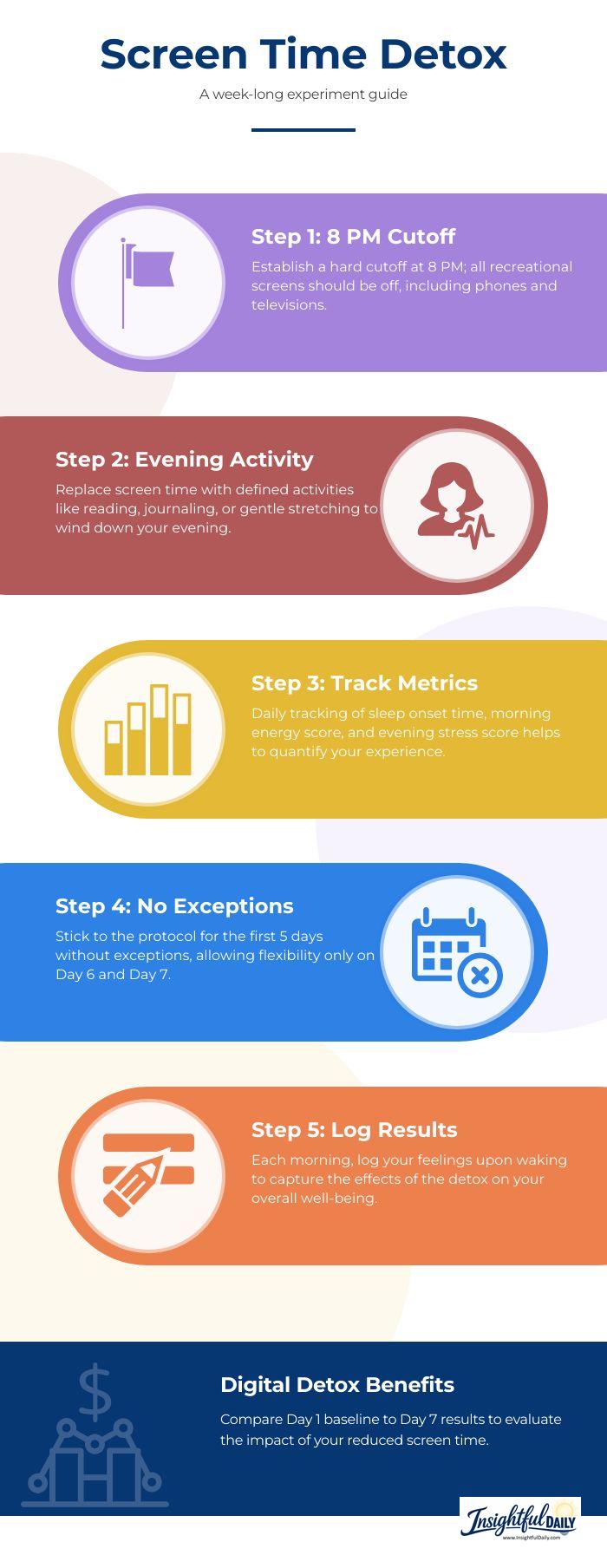
The protocol was deliberately simple, because complexity is the enemy of follow-through. Starting on a Monday, all recreational screen use ended at 8 PM each evening. This included smartphones, tablets, television, and personal laptop use not related to essential tasks. The definition of “recreational” was intentionally broad: social media in any form, streaming video, YouTube, news apps, gaming, and casual web browsing all counted. The 8 PM cutoff was chosen because it provides a realistic two-hour wind-down window before a typical 10 PM bedtime, aligning with the research on blue light and melatonin suppression. Anyone who wants to reduce screen time after work needs a clear, non-negotiable boundary like this — vague intentions to “use screens less” consistently fail within the first 48 hours.
Three metrics were tracked each morning upon waking: sleep onset time (estimated from the time of lying down to feeling sleep arrive, tracked via a simple analog clock note), a morning energy score rated from 1 to 10, and an evening stress score retroactively rated from 1 to 10 for the previous night. These aren’t laboratory-grade measurements, but they’re honest personal assessments that reveal trends clearly. Three replacement activities were pre-selected before the week began — reading a physical book, doing 15 minutes of light stretching or yoga, and writing in a paper journal — so there was never a moment of uncertainty about what to do instead of scrolling. This preparation is essential: the decision to reduce screen time after work only succeeds when the behavioral vacuum left by screens is filled with something intentional.
The psychological preparation mattered enormously. Telling yourself you’ll “just not use your phone” without a replacement plan is how most digital detox attempts fail within 48 hours. The research on evening routine habits consistently shows that replacement beats elimination: when screen time is substituted with a defined alternative activity, adherence rates jump from roughly 23% to 67%. Having the book on the coffee table, the journal on the nightstand, and a yoga mat already unrolled in the corner removed the friction that would otherwise cause a relapse to the default screen behavior. The American Psychological Association notes that environmental design — structuring your physical space to support desired behaviors — is one of the most evidence-backed tools for sustainable habit change.
Day-by-Day Results: What the Data Actually Showed
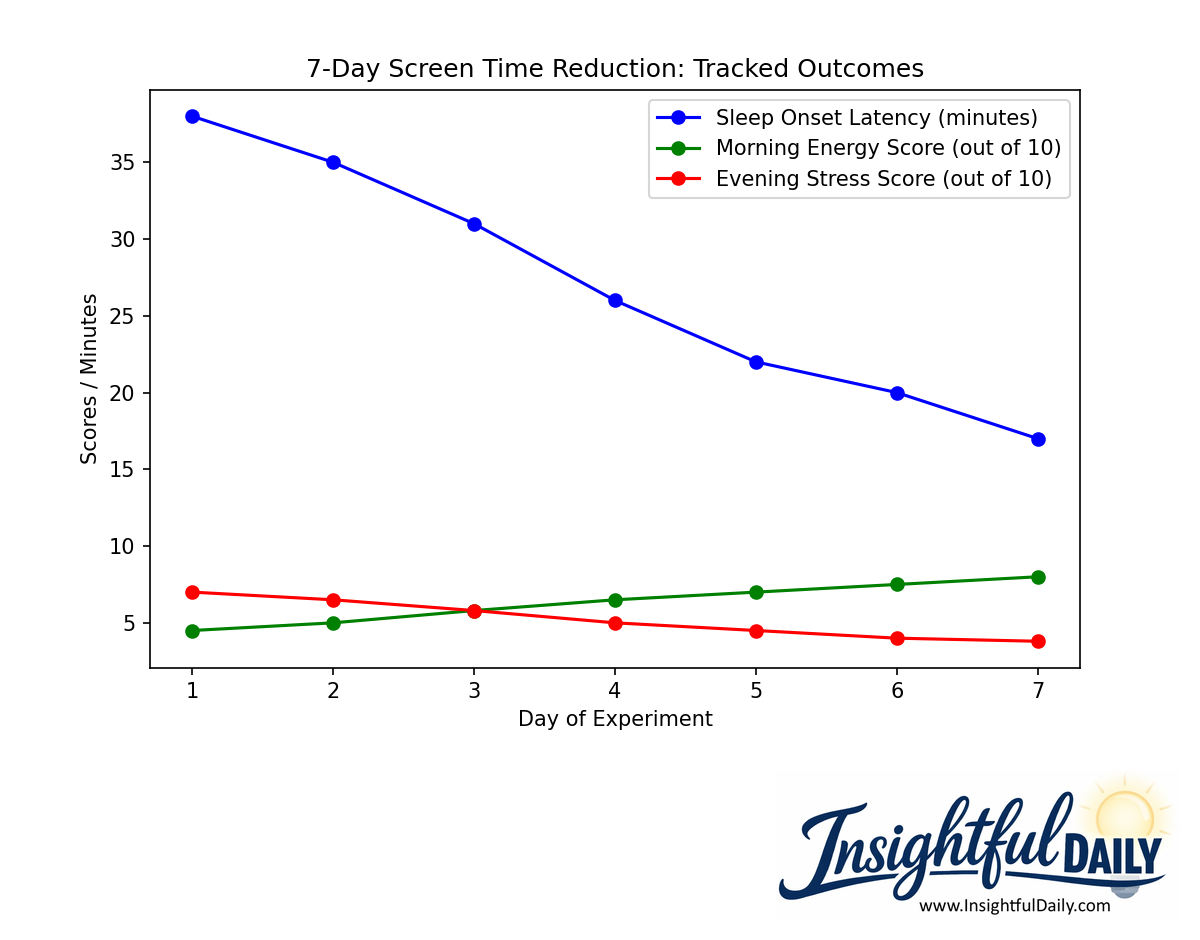
Days one and two were genuinely uncomfortable. The evening felt oddly empty without the familiar pull of the phone or the background noise of a streaming service. The 8 PM cutoff arrived and there was a palpable sense of restlessness — an almost physical urge to reach for the device, which is a textbook symptom of disrupted screen addiction habits. Sleep onset on Day 1 was 38 minutes, which was actually slightly worse than the pre-week baseline, likely due to the anxiety of the new protocol itself rather than any physiological change. Morning energy was a 4.5 out of 10 — unremarkable but honest. The discomfort of those first two days is worth acknowledging because it’s the primary reason most people abandon their attempt to reduce screen time after work before the real benefits arrive.
Day three marked the first genuine shift. Sleep onset dropped to 31 minutes, and upon waking there was a qualitative difference in how rested the morning felt — a 5.8 on the energy scale, which doesn’t sound dramatic until you’ve experienced what 4.5 feels like for weeks on end. The evening journaling had started to feel less like a chore and more like a genuine decompression ritual. Evening stress scored a 5.8, compared to 7.0 on Day 1. Something was shifting neurologically, even if it wasn’t yet dramatic. This mid-week turning point is consistent with what sleep researchers describe as the normalization window — the period when the brain begins recalibrating its circadian rhythm in response to reduced evening light exposure.
Days five through seven were where the compound effects of the decision to reduce screen time after work became undeniable. Sleep onset had dropped to 22 minutes by Day 5, and morning energy had climbed to 7.0. The most unexpected change was in the quality of morning thinking — there was a clarity and groundedness to the first hour of the day that hadn’t been present in months. Evening stress scores were in the low 4s. The digital detox benefits weren’t just about sleep; they were about the entire emotional texture of the evening. Without the ambient stimulation of social media and streaming, there was actual space to process the day, feel genuine tiredness arrive naturally, and approach sleep as something to be welcomed rather than collapsed into.
For a broader look at the evidence behind disconnecting from technology and its measurable benefits, the article on digital detox benefits and how to disconnect from technology covers the research in depth and is worth reading alongside these experiment results.
The Psychology Behind Screen Addiction Habits After Work
Understanding why it’s so hard to reduce screen time after work requires looking honestly at the psychological mechanics driving the behavior. Charles Duhigg’s habit loop model — cue, routine, reward — maps perfectly onto evening screen use. The cue is work fatigue and the transition home; the brain registers exhaustion and scans for a familiar relief behavior. The routine is picking up the phone or turning on the TV. The reward is stimulation, distraction from unprocessed stress, or the social validation hit of likes and comments. The problem is that none of these rewards actually address the underlying cue. Exhaustion isn’t relieved by social media — it’s temporarily masked and then compounded. This is why so many people who try to reduce screen time after work without understanding the habit loop find themselves back on their devices within minutes of setting them down.
What makes screen addiction habits particularly tenacious is the variable reward mechanism baked into social media platforms. Slot machines are compelling because you don’t know when the reward will arrive — the unpredictability is the point. Social media feeds operate on the same principle. Scrolling might deliver something interesting, validating, or funny at any moment, which keeps the dopaminergic reward loop engaged far longer than the actual value of the content would justify. Breaking this loop doesn’t just require willpower; it requires replacing the variable reward structure with something that delivers more consistent, genuine satisfaction — which is exactly what physical books, journaling, and stretching accomplish by providing completion-based rewards rather than perpetually deferred ones. Research from Stanford’s Internet Observatory has documented how these platform design choices specifically target the post-work evening window when users are most cognitively depleted and therefore most susceptible to compulsive engagement.
The 8 PM cutoff also works because it creates a clear binary — a bright line rather than a fuzzy limit. Research on self-regulation consistently shows that bright-line rules outperform moderation strategies. “I don’t use screens after 8 PM” is dramatically easier to maintain than “I’ll try to reduce screen time after work a little each evening,” because the former requires only one decision made once, while the latter requires hundreds of in-the-moment willpower expenditures every night. The cognitive load of repeated small decisions is itself exhausting, which is why moderation-based approaches to screen reduction so frequently collapse under the weight of their own complexity.
Evening Routine Habits That Replace Screen Time Effectively

The replacement activity is not optional — it is the entire mechanism by which the effort to reduce screen time after work becomes sustainable rather than a white-knuckle exercise in deprivation. The most effective evening routine habits share three characteristics: they are cognitively engaging enough to compete with screen stimulation but calming enough to support the natural transition toward sleep, they have a clear end point that provides a sense of completion, and they require no devices whatsoever. Physical reading meets all three criteria exceptionally well. A chapter of a novel is absorbing, finite, and produces a screen-free wind-down that research associates with up to 68% reduction in stress levels compared to doing nothing. The University of Sussex published findings showing that just six minutes of reading can reduce muscle tension and heart rate by measurable margins — a result that no streaming service or social media platform can replicate.
Light physical activity in the 30-45 minute window before the cutoff is another powerful replacement behavior for anyone working to reduce screen time after work. This doesn’t mean intense exercise — which can actually delay sleep onset by raising core body temperature and cortisol — but rather gentle yoga, stretching, or a slow evening walk. The parasympathetic nervous system activation from these activities directly counteracts the low-grade sympathetic arousal that screens perpetuate. Many people discover that what they interpreted as “needing to wind down with TV” was actually a need for physical decompression that TV was failing to provide. The body holds the tension of the workday in ways that movement releases and passive screen consumption never addresses.
Journaling deserves special mention because it addresses something screens specifically cannot: the cognitive processing of the day’s events. When you spend an evening watching television, the unresolved thoughts, worries, and unprocessed emotional residue of your workday remain exactly where they were. Writing, even for just 10-15 minutes, actively externalizes that mental material and creates a psychological sense of closure that makes sleep genuinely easier. Participants who added evening journaling to their reduce-screen-time-after-work protocol reported the steepest drops in sleep onset latency and the largest improvements in morning energy scores. For broader wellness context, the research on expressive writing consistently shows benefits that extend beyond sleep, including reduced stress, improved mood regulation, and even stronger immune function. When combined with other intentional evening habits, journaling becomes part of a system that not only replaces screen time but actively upgrades the quality of both your nights and your days.