
I used to change my mornings constantly. Some days I tried to be productive right away. Other days I checked my phone first, moved slowly, or started work without any clear routine. So I tried following the same simple morning routine every day to see whether consistency actually made the rest of the day feel easier. The biggest benefit wasn’t perfection. It was having fewer decisions to make first thing in the morning.

The Science Behind Morning Routine Benefits: What’s Actually Happening in Your Body
To understand why a consistent morning routine produces such measurable results, you first need to understand what your body is doing the moment you open your eyes. Your circadian rhythm — the internal 24-hour biological clock governed by a tiny region of the brain called the suprachiasmatic nucleus — controls the timing of nearly every physiological process in your body, from cortisol production to body temperature to digestive enzyme release. When you wake at the same time every day, you synchronize your behavior with this internal clock in a way that optimizes what scientists call the Cortisol Awakening Response (CAR). This synchronization is one of the most underappreciated morning routine benefits available to anyone willing to commit to a consistent schedule.
The CAR is a natural spike in cortisol that occurs 20 to 30 minutes after waking, and it is one of the most important physiological events of your day. Despite cortisol’s reputation as a “stress hormone,” its morning surge is actually beneficial — it sharpens mental alertness, mobilizes energy, supports immune function, and prepares your cardiovascular system for the demands of the day. Research published in the journal Psychoneuroendocrinology has found that people who wake at consistent times have stronger, more robust CARs compared to those with irregular sleep schedules. A blunted CAR, by contrast, is associated with fatigue, brain fog, and increased susceptibility to illness. Simply put, waking at the same time each morning is not just a preference — it is a biological advantage that forms the physiological foundation of all other morning routine benefits.
Beyond cortisol, consistent structured mornings also influence the release of serotonin and dopamine — the neurotransmitters most directly associated with mood, motivation, and reward. Morning light exposure triggers serotonin production in the brain, which later converts to melatonin at night, improving sleep quality and creating a virtuous cycle. When your morning routine includes exposure to natural light within 30 minutes of waking — a recommendation strongly endorsed by neuroscientist Dr. Andrew Huberman of Stanford University — you are essentially calibrating your entire neurochemical system for the day ahead. This light-driven serotonin boost is one of the simplest and most accessible morning routine benefits you can activate without any special equipment or significant time investment.
How Daily Habits Consistency Rewires Your Brain Over Time
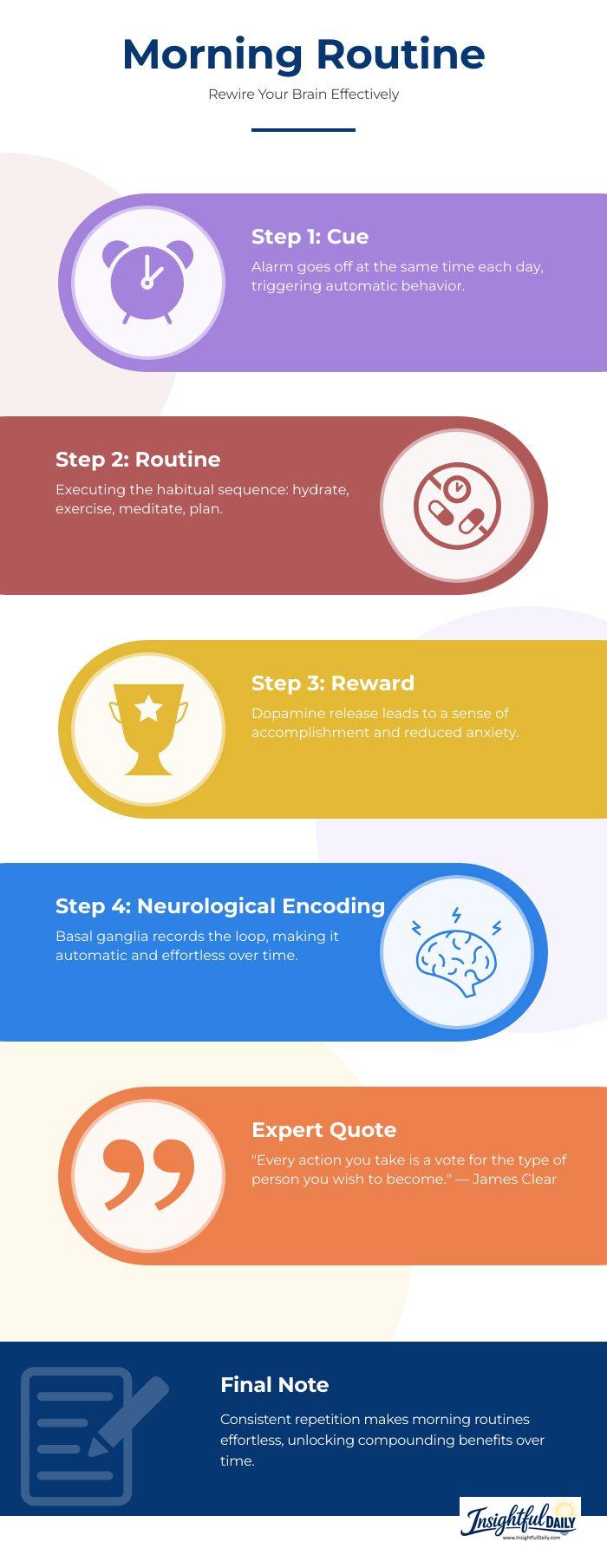
One of the most fascinating aspects of maintaining daily habits consistently is what happens at the neurological level after repeated practice. When you perform the same sequence of behaviors every morning — whether that is brewing coffee, doing a brief workout, meditating, or reviewing your goals — your brain begins encoding that sequence in the basal ganglia, a region associated with procedural memory and automatic behavior. MIT neuroscientist Ann Graybiel’s groundbreaking research demonstrated that once a habit is sufficiently ingrained, the cortex (the thinking, effortful part of the brain) essentially disengages, and the basal ganglia takes over to execute the routine automatically. This neurological shift is one of the most profound long-term morning routine benefits, because it means your most important daily behaviors eventually cost you almost no willpower to execute.
This process of automaticity is not just a convenience — it is a profound cognitive resource-saver. Psychologist Roy Baumeister’s research on decision fatigue showed that the quality of human decision-making deteriorates with each choice made throughout the day. Every decision, from what to eat to which email to answer first, draws from a finite pool of cognitive energy. A well-established morning productivity routine essentially converts your highest-priority behaviors into automatic actions that require almost no conscious deliberation, preserving your mental bandwidth for the complex, creative, and strategic decisions that define your professional and personal life. This is why figures like Barack Obama and Steve Jobs famously simplified their morning decisions — they understood intuitively what behavioral science has since confirmed about the morning routine benefits of reducing early-day cognitive load.
A landmark study by Phillippa Lally and colleagues at University College London found that on average, habits take 66 days to form — not the often-cited 21 days. Crucially, the study found that missing a single day had minimal impact on long-term habit formation, which is reassuring for anyone building a new routine. Morning habits, in particular, tend to be among the most durable once established, because the temporal cue of waking up is so consistent and reliable that it becomes a powerful trigger in the habit loop of cue-routine-reward. Understanding this timeline helps set realistic expectations: the full spectrum of morning routine benefits becomes available not in the first week, but after sustained commitment over two to three months.
Productivity Routine: The Morning Habits That Deliver the Biggest Morning Routine Benefits
Not all morning habits are created equal when it comes to their measurable impact on daily performance. Research across exercise science, nutritional psychology, and cognitive neuroscience points to four core categories of morning activity that deliver the most significant and well-documented morning routine benefits: physical movement, nutritional choices, mindfulness practices, and structured planning. Understanding what each of these contributes — and why — allows you to build a morning productivity routine that is both evidence-based and personally sustainable.
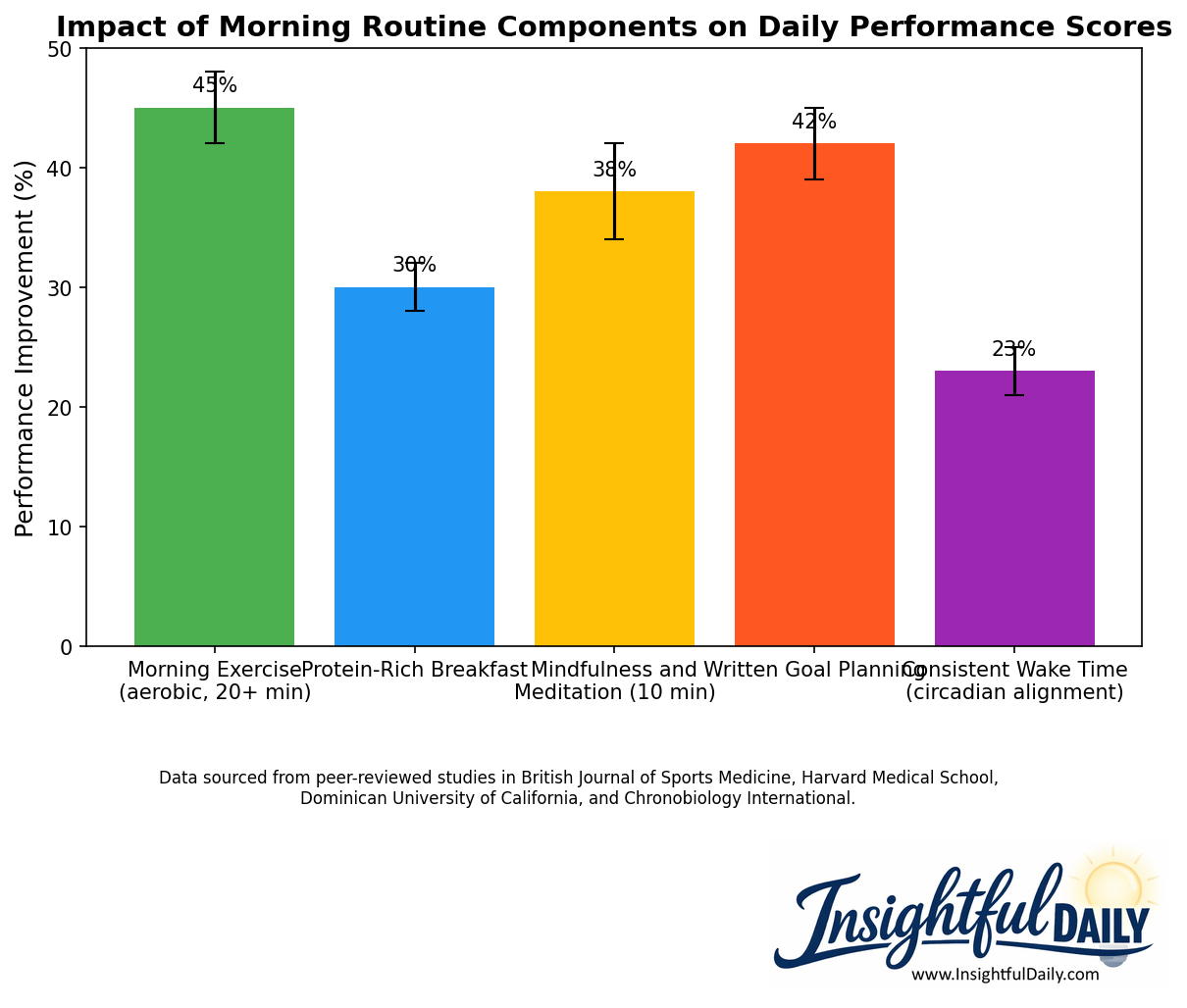
Physical exercise in the morning stands out as perhaps the single highest-return morning investment you can make. Multiple studies — including landmark research from the University of British Columbia — have demonstrated that aerobic exercise significantly increases levels of brain-derived neurotrophic factor (BDNF), a protein that stimulates the growth of new neurons and strengthens synaptic connections. The practical effect is improved memory, faster learning, sharper focus, and greater creative thinking throughout the day. A 2022 study published in the British Journal of Sports Medicine found that even a 20-minute brisk walk in the morning was enough to produce measurable improvements in executive function and working memory by mid-morning. Additionally, morning exercisers show dramatically better adherence rates — research suggests they are approximately 40% more likely to maintain their fitness habits long-term compared to people who attempt to exercise later in the day, when schedule conflicts and decision fatigue tend to derail good intentions. This adherence advantage is itself one of the most practically significant morning routine benefits for anyone trying to build lasting fitness habits.
Nutritional choices in the morning have a direct and significant impact on cognitive performance. A protein-rich breakfast that stabilizes blood glucose levels has been shown to improve sustained attention, reduce mid-morning energy crashes, and lower cortisol levels that might otherwise spike in response to low blood sugar. Whether you choose to eat immediately upon waking or practice a time-restricted eating window, the key is making that choice deliberately as part of your structured morning rather than reactively. Intentional nutrition is one of the morning routine benefits that pays dividends not just in the hours immediately following breakfast, but in your overall metabolic health over the long term. You can also explore how sleep consistency and morning nutrition intersect with immune health in our article on Vitamin D deficiency symptoms, since Vitamin D levels are closely tied to the energy and mood needed to sustain a consistent routine.
Mindfulness and meditation deserve special mention as morning routine components because of the speed with which they produce measurable neurological changes. Harvard Medical School researcher Sara Lazar’s groundbreaking neuroimaging study found that just eight weeks of regular meditation — even sessions as brief as 10 minutes — produced measurable thickening of the prefrontal cortex (associated with attention and self-awareness) and shrinkage of the amygdala (associated with fear and stress reactivity). Practicing mindfulness in the morning means you begin the day with a more regulated nervous system, making you less reactive to stressors and better able to maintain focus during high-pressure situations. For anyone dealing with chronic stress or anxiety, this is among the most immediately accessible morning routine benefits available, and it requires nothing more than a quiet space and a few minutes of intentional breathing or guided meditation.
Planning and intentional goal-setting round out the most impactful morning habits. Research from the Dominican University of California found that people who write down their goals are 42% more likely to achieve them compared to those who merely think about their goals. Spending even five to ten minutes each morning reviewing your priorities, writing a short to-do list, or journaling about your intentions creates a cognitive roadmap that makes your entire day more purposeful and efficient. This kind of intentional daily habits consistency is what separates high performers across virtually every field from their less structured counterparts, and it is one of the morning routine benefits that requires the least time investment for the greatest return.
Morning Routine Benefits That Compound Over Weeks and Months
One of the most compelling — and least discussed — aspects of maintaining a consistent morning routine is how the benefits compound over time. In the world of finance, compound interest is celebrated because small gains accumulate into enormous returns over years. The same mathematical reality applies to daily behavioral habits. Marginal gains theory, popularized by British Cycling coach Dave Brailsford when he transformed Team GB into Olympic gold medalists, holds that improving any system by just 1% per day results in outcomes that are approximately 37 times better after one year. A morning routine that makes you 1% more focused, 1% less stressed, or 1% more physically energized does not just produce incremental daily improvements — it creates a dramatically different life trajectory over the span of months. This compounding dynamic is arguably the most transformative of all morning routine benefits, and it is the reason why consistency matters far more than perfection.
Longitudinal research supports this compounding effect in concrete health terms. A 10-year study from Johns Hopkins University tracking adults across different lifestyle categories found that individuals who maintained consistent morning habits — including regular sleep-wake schedules, morning physical activity, and structured nutrition — had significantly lower rates of metabolic syndrome, better cognitive aging outcomes in their 50s and 60s, and higher self-reported measures of life satisfaction and sense of purpose. These are not trivial outcomes. They represent the difference between thriving and merely surviving across the full arc of adulthood, and they underscore why investing in morning routine benefits today pays dividends that extend decades into the future.
There is also a powerful psychological compounding effect worth acknowledging. Successfully completing your morning routine creates what psychologists call a “small wins” cascade — each completed habit triggers a micro-release of dopamine and reinforces your self-concept as a disciplined, capable person. Over time, this builds genuine confidence and identity-level change. James Clear, author of Atomic Habits, articulates this precisely: every time you follow through on your morning routine, you cast a vote for the kind of person you want to become. Enough votes cast consistently enough, and your identity genuinely shifts. You stop being someone who “is trying to be healthy” and become someone who simply is healthy — because your automatic behaviors reflect that identity every single morning. This identity transformation is one of the deepest and most lasting morning routine benefits that behavioral science has documented.
It is also worth noting that the mental health benefits accumulate in measurable ways. Maintaining predictable structure is one of the most effective non-pharmacological tools for managing anxiety and depression. Research published in Behaviour Research and Therapy found that routine disruption is a key predictor of mood instability in both clinical and non-clinical populations. Conversely, restoring structured mornings is often one of the first interventions recommended in cognitive behavioral therapy for people recovering from depressive episodes or anxiety disorders. If you have ever struggled with mood management, starting with something as simple as consistent waking, hydration, and five minutes of mindfulness can create a meaningful foundation of stability. This principle also intersects with broader wellness strategies — our coverage of digital detox benefits discusses how avoiding screens in the first hour of morning is widely recommended for anxiety reduction and improved morning focus, making it a natural complement to any structured morning routine.

How to Build a Morning Routine That Actually Sticks
Understanding the morning routine benefits available to you is one thing — building a routine that actually survives contact with the chaos of real life is another challenge entirely. The behavioral science here is clear: the most durable morning routines are not the most ambitious ones. They are the ones designed with psychological realism, anchored to existing triggers, and built incrementally over time rather than overhauled overnight. Many people make the mistake of designing an elaborate two-hour morning protocol after reading about the habits of elite performers, only to abandon it within two weeks when the demands of real life make it unsustainable. The research suggests that habit adherence is far more strongly tied to consistency than to intensity. Small, repeatable actions performed daily create stronger behavioral grooves than occasional bursts of highly optimized routines. By starting with just one or two keystone habits — like waking at the same time each day or spending five minutes planning your priorities — you build a foundation that can expand naturally as those behaviors become automatic.